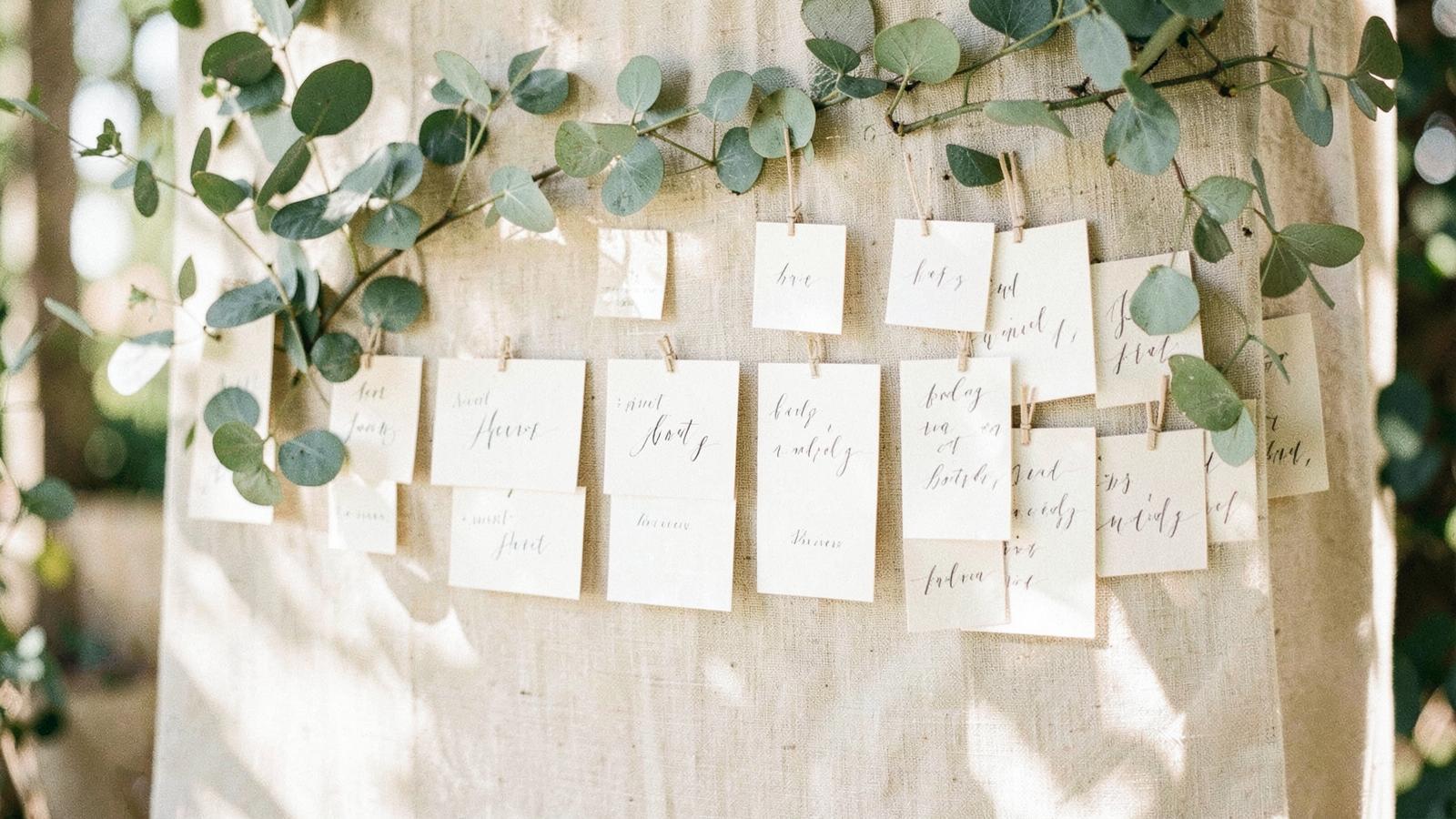
How to make a wedding seating chart
Seating is the last big puzzle of wedding planning, and it only feels impossible because most couples start too early. Wait for RSVPs, get the real floor plan, then work group by group — not guest by guest.
Start with table shapes and capacity
Your table mix determines how many groups you can keep intact. Ask your venue for exact sizes — a 60-inch round and a 72-inch round look identical on a floor plan but differ by four seats.
| Table | Seats | Best for |
|---|---|---|
| Round (60 in) | 8 guests comfortably, 10 tight | Classic receptions — everyone can see each other, easy conversation. |
| Round (72 in) | 10–12 guests | Larger guest counts in the same footprint; slightly harder to talk across. |
| Long banquet (8 ft) | 8–10 guests | Family-style dining, long-table looks, tight or narrow rooms. |
| King / feasting table | 16–24 guests | Statement centerpieces and mixed groups; needs a wide room. |
| Square (60 in) | 8 guests | Modern layouts; pairs well with a mix of rounds. |
Quick math: divide your confirmed guest count by the seats per table and add one spare table. If you have 140 guests at 60-inch rounds, that's 18 tables — 17 plus one buffer for late changes. Or let the calculator below do it for you.
Seating chart calculator
Adjust your guest count, table size, and head table style to get the table count, leftover seats, and the room size you need to book.
Seating chart calculator
Enter your guest count and table size to see how many tables you need, how many seats are left over, and roughly how much floor space the room has to hold.
130 guests · 15 guest tables · 2 kids tables · sweetheart table for 2. Estimates assume standard chair clearance; confirm the final count with your venue.
The six-step seating process
1. Lock the guest list first
You cannot seat guests you haven't confirmed. Wait until RSVPs are roughly 90% in — usually 3–4 weeks before the wedding.
2. Get the real floor plan
Ask your venue for the exact table count, table sizes, and where the dance floor, bar, and band or DJ sit. Table count drives everything else.
3. Sort guests into groups
Family, partner's family, college friends, work friends, neighbors, plus-ones. Every guest should belong to exactly one anchor group.
4. Place the anchor tables
Immediate family and the wedding party go closest to the head table. Older guests go away from speakers. Kids' tables go near their parents.
5. Fill in the mixers
Seat leftover singles and plus-ones with the friendliest group they overlap with — not at a table of strangers.
6. Walk the room mentally
For each table ask: does at least one person here know two others? If not, reshuffle.
Head table options
Traditional head table
Couple plus the full wedding party in a long line facing the room. High-impact, but splits the wedding party from their dates.
Sweetheart table
Just the two of you. Easiest option, gives you a breather, and lets the wedding party sit with their partners.
Family-style head table
Couple with both sets of parents and grandparents. Warm and intimate — best when both families get along.
King's table
Couple in the center of a long feasting table with the wedding party on both sides. Photographs beautifully, needs the space.
The hard cases
| Situation | How to handle it |
|---|---|
| Divorced parents | Give each parent their own table with their own family and friends. Never split the difference by seating them together to look neutral. |
| Family tension | Separate by distance, not by line of sight. Put them in different quadrants of the room so they don't feel monitored. |
| Plus-ones you've never met | Seat them next to their date, then with the most sociable table in their date's group. |
| Kids | Under 8: seat with parents. Ages 8–14: a dedicated kids' table with an activity kit works well. Teens: seat with the young adults. |
| Solo guests | Never a table of leftovers. Place each solo guest with a group where they know at least one person. |
| Vendors and coordinators | Reserve two seats near the exit for your planner or coordinator if the contract includes a meal. |
Escort cards, place cards, or a chart?
- Seating chart display — one large sign at the entrance. Cheapest, fastest for guests, and easy to reprint if something changes.
- Escort cards — individual cards with a guest name and table number. Flexible up to the last minute and doubles as a design moment.
- Place cards — assigns the exact seat. Required for plated dinners with multiple entrée choices so servers can match meals.
Whatever you choose, give your coordinator a printed copy of the final chart and email a copy to the caterer and the venue the week of the wedding.
Your seating worksheet
Before you place a single name, fill in these five lines:
- Confirmed guest count (adults / kids):
- Table count and sizes from the venue:
- Head table style:
- Guests who must be near the front (parents, grandparents, elderly guests):
- Guests who must be kept apart:
Those five answers resolve roughly 80% of the chart. The rest is grouping friends and filling gaps.
Who you'll need to share the chart with
Your table count decides what you rent and who you brief. Once the numbers above are set, send the final chart to your caterer, rental company, and venue coordinator the week of the wedding.
- Caterers — they set final counts and match plated meals to seats.
- Venues — confirm the real table inventory and room square footage before you finalize.
- Rentals — order the table mix, linens, and the one spare table.
- Browse the full vendor directory by ZIP code to find local help.
Frequently asked questions
When should I finalize my wedding seating chart?
Build the first draft when RSVPs hit about 90%, then finalize 7–10 days before the wedding. Most caterers need final counts and table assignments a week out.
Do I need assigned seats or just assigned tables?
Assigned tables are enough for most weddings. Assign specific seats only for the head table, parent tables, or a plated dinner where servers need to match meal choices to seats.
How many guests fit at a wedding table?
A 60-inch round seats 8 comfortably (10 if tight), a 72-inch round seats 10–12, and an 8-foot banquet table seats 8–10.
Who sits at the head table?
Traditionally the couple and the wedding party. A sweetheart table for just the couple, or a family-style table with parents and grandparents, are both common modern alternatives.
How do I handle guests who don't know anyone?
Anchor every table with at least one connection. Each guest should be able to name two people at their table — that single rule prevents most awkward tables.